
Shadow Banning: The Silent Killer of Your Riding’s Support – And How to Fight Back
How bad is it? Bad enough that you can “look fine” online… and still be locally invisible.
Author: Wade MacCallum, Founder
Contact: wade@roguemanagement.ca
Here’s the problem: on Meta, the most damaging outcome isn’t getting banned. It’s getting quietly de-prioritized.
Meta doesn’t need to take your post down to neutralize it. It can simply show it to fewer people and Meta openly describes this as a normal part of how the feed works.
Meta’s own Transparency Center explains that some content is “demote[d] (or show[n] lower in Feed)” as part of feed ranking. And Meta’s 2019 policy framing is explicit about the approach: remove, reduce, and inform—including reducing the spread of content that may not violate rules.
Now layer in what Meta has also done recently to political reach. A 2024 analysis of prominent Instagram accounts found political content reach down ~65% on average after Meta’s political-content limit took effect. That isn’t “shadow banning” in the cartoon sense, it’s a platform-wide distribution shift that hits politics especially hard.
So the question for Conservative campaigns becomes very practical:
Are you losing arguments… or losing delivery?

“At face value, this pattern could be interpreted as evidence of bias against conservatives.”
— Yale Insights, summarizing a Nature Human Behaviour study on Twitter suspensions during the 2020 election (2024).
What “shadow banning” means on Meta (whether they use the term or not)
Meta rarely uses the phrase “shadow banning.” The reality is closer to visibility filtering: distribution controls that decide whether content reaches feeds, recommendations, search surfaces, and non-followers.
Meta’s own language is clear: it demotes certain types of content and it reduces distribution for categories it considers problematic or low quality.
And in January 2025, Meta publicly acknowledged something campaigns feel constantly: their automated systems “demote too much content” that they predict might violate standards.
That matters because “demotion” is silent. No notice. No penalty banner. No explanation. Just… less reach.

“There was a bias. I’d come on shift and see that conservative topics that were popular were not trending.”
— Former Facebook Trending News curator, quoted in Gizmodo (2016)
Why this can swing a riding without anyone noticing
A riding campaign lives and dies on local persuasion. But Meta doesn’t optimize for “local persuasion.” It optimizes for engagement.
So when distribution tightens, whether from political-content limits, demotion systems, or simple algorithm drift this is what happens:
Your supporters still see you (often).
Your critics still see you (sometimes even more).
But persuadable locals… stop seeing you.
And that is where elections are won.
“We control the amplification of your content quite a bit. And normal people do not know how much we do.”
— Twitter engineer, internal discussion disclosed in The Twitter Files (2022)
The pattern we see regularly with Conservative pages
Some candidates have big followings and decent engagement on Facebook/Instagram but inside the riding, the impact is weak. People haven’t seen the posts. The message doesn’t show up in local conversation. The “online reality” doesn’t match the doors.
That can happen even without overt suppression, for a simple reason:
Platforms drift away from geography (quietly and predictably)
Meta optimizes for engagement efficiency, not locality. If your posts resonate outside your riding: national issues, viral moments, high-emotion debates, the system learns to deliver you to the audiences most likely to react, regardless of where they live.
Local voters often engage more quietly. They read, consider, and move on. To an algorithm, quiet relevance can look like weak performance.
The result is subtle but dangerous: your audience becomes large, but less local. Then when political-content limits or demotion systems layer on top, local visibility often shrinks first because it’s less “algorithmically rewarding.”
So you end up with a page that looks healthy while many in your riding is not seeing your content.

“Think about visibility filtering as being a way for us to suppress what people see to different levels. It’s a very powerful tool.”
— Senior Twitter employee, internal communication released in The Twitter Files, reported by Bari Weiss (2022)
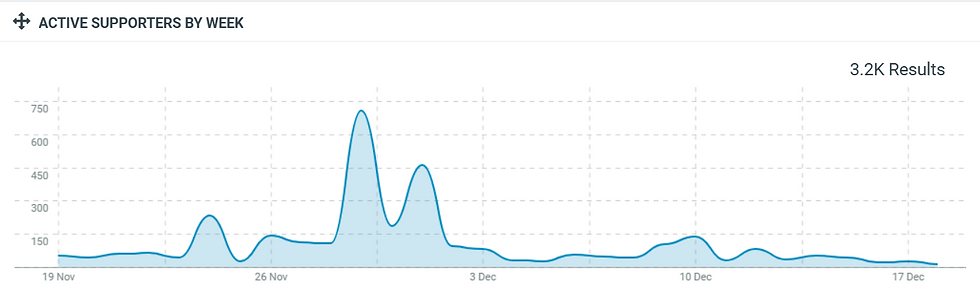
How to confirm the pattern (using your own charts)
This is where your work becomes a competitive advantage.
If you have charts showing riding support over time (or local opinion estimates), compare them directly to your page performance metrics, especially reach and engagement.
When those lines diverge with page support holding steady (or rising) while local distribution collapses you’re not looking at “content fatigue.” You’re looking at a delivery problem.
Ask yourself what actually matters:
Do I want a big page?
Or do I want to win my riding—and keep winning it?
Because your riding is not a vanity metric. It’s your political foundation.
How to fight back (Meta-first, with X as a secondary lane)
On Facebook, you need two tracks: organic signals and controlled delivery.
Organic is simple: talk like a neighbour, not a commentator. Keep posts hyper-local. Stay active in the comments early. Facebook still responds to conversational momentum.
Controlled delivery is the safety net: tightly geo-targeted ads ensure your message reaches persuadables inside the riding when organic distribution gets unreliable. This isn’t about “boosting everything.” It’s about guaranteeing local delivery for your most important messages.
Also consider building a community group as a parallel channel. Pages can be demoted; groups often behave differently.
Instagram is increasingly “recommendations-driven,” and Meta’s political-content limits mean political content can travel less by default. So you win by designing content that people carry for you: shares, saves, DMs.
Use local language (town names matter). Use collabs with local voices. Build repeatable formats (weekly “riding update,” quick issue explainers) so the algorithm learns what you are.
X
X is useful for amplification and rapid response, but you don’t want your riding strategy dependent on it. The Twitter Files showed internal visibility tools existed there too (and that visibility controls can be quietly applied). Use X to shape narratives and drive people to channels you own.
YouTube
If you want the most durable, and underutilized, channel for political communication, it’s YouTube. One weekly riding update, one weekly issue explainer, and then turn each into several Shorts. Titles should be search-friendly and local (“What this carbon tax change means for [Town]”).
OTHER CHANNELS: eg. Reddit, Blusky, Blogs, etc
You can't be everywhere at once, But these channels are very popular with certain highly engaged members of society - and often this is where narratives, and movements, begin. Monitoring them can be a critical measure of potentially heading to other more popular channels so you can get ahead of any potential issues.
Email + SMS (your insurance)
A list you own can’t be demoted by an algorithm. Build it slowly, consistently, and make every platform quietly feed it.
The point isn’t outrage. It’s discipline.
Meta has openly described demotion and distribution reduction as part of how its systems work. Meta has also rolled out political-content limits that correlate with a large drop in reach for political content on Instagram.
So don’t guess. Measure.
Compare your riding support charts to your platform reach. Watch for geographic drift. And keep returning to the question that decides your future:
Is my content helping me win my riding, or just helping me feel heard somewhere else?
Citations
Meta Transparency Center: feed ranking and “demote/show lower in Feed.”
Meta Transparency Center: “reducing/lowering distribution of problematic content.”
Meta Newsroom (Jan 7, 2025): acknowledgment that Meta systems “demote too much content” predicted to violate standards.
Meta Newsroom (Apr 2019): “remove, reduce, inform” approach including reducing spread.
Accountable Tech report (2024): political content reach down ~65% on prominent Instagram accounts after political-content limits.
Reporting on Meta political content opt-in / reduced recommendations (Mar 2024):
Twitter Files references (kept secondary): Congress PDF summary + The Free Press + CBS summary of visibility limiting tools.


Comments